
Screen Overview #
Configure Load Balancing information to maintain balance with other electricity usage in the home.
It is recommended to set the Household Current Limit (A) value below the actual current limit for safety.
Monitoring device information provided may vary by country.
Feature Details #
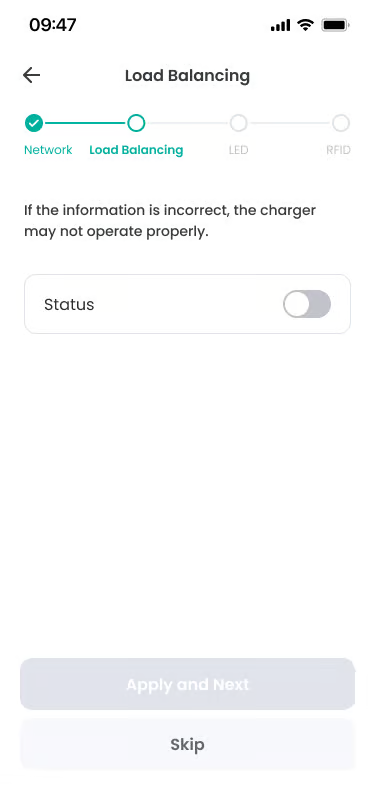
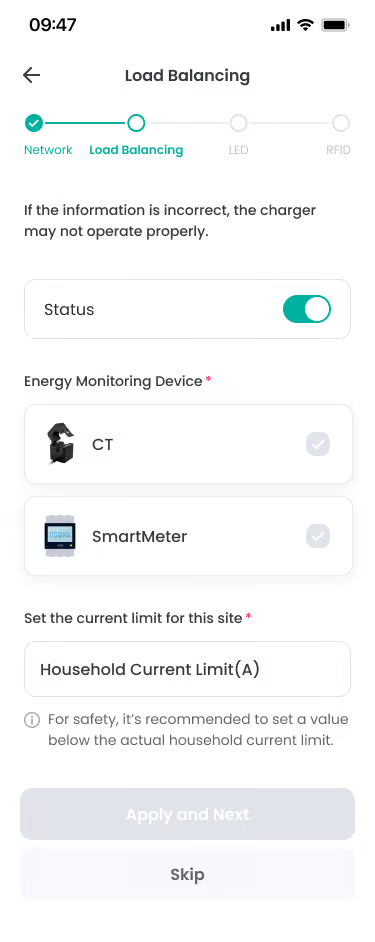
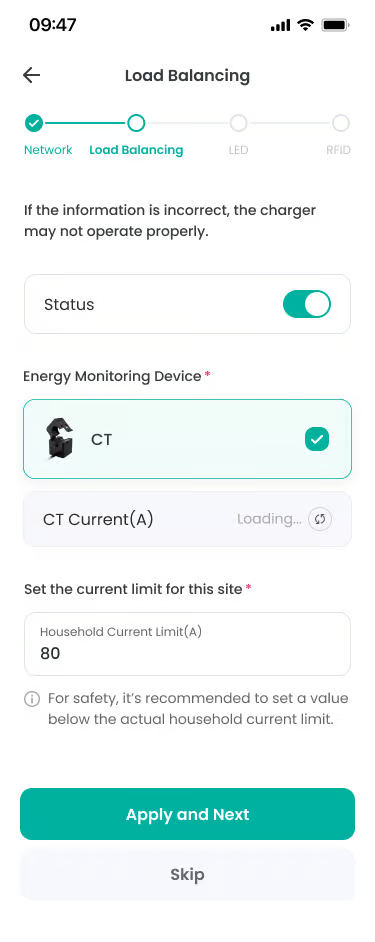
- Navigation Area
Location: Top of screen
Functionality: Displays installation progress steps. Consists of 4 steps: Network, Load Balancing, LED, RFID, and currently Load Balancing step is active.
Notes: Not touchable. Current step is active, and previous steps are displayed as check marks. - Load Balancing ON/OFF Setting
Location: Top of screen
Functionality: Controls activation/deactivation of load balancing feature. If toggle is ON, items required for load balancing settings are provided.
Notes: Default is inactive (Off). - Energy Monitoring Device Section
Location: Displayed when Status toggle is activated
Functionality: You can select a device to monitor total home power usage.
Notes: Monitoring device information provided may vary by country. - CT
Location: Energy Monitoring Device Area
Functionality: Measures total home current using CT sensors.
Notes: When selected, real-time “CT Current (A)” information being measured is provided, and “Household Current Limit (A)” input field is displayed. - Check Measured CT Current (A) Info
Location: Within CT Item
Functionality: Real-time “CT Current (A)” information currently being measured is provided up to two decimal places.
Notes: If a negative (-) value is read, CT Clamp may have been installed in the opposite direction, so please check. - Enter Household Current Limit (A)
Location: Bottom of screen
Functionality: Sets the current limit for the entire home. It means the main breaker capacity of the house, and the charger adjusts power so as not to exceed this limit.
Notes: Must be entered if Load Balancing Status is On. - Apply and Next Button
Location: Bottom of screen
Functionality: Applies load balancing settings to the charger and moves to the next step (LED setting).
Notes: Activated when all mandatory input values are filled. - Skip Button
Location: Bottom of screen
Functionality: Skips load balancing settings and moves to the next step. The charger operates with fixed current and load balancing feature is not applied.
Notes: Always available.
Additional Info #
- Load Balancing Feature: Automatically adjusts charging power by monitoring other electricity usage in the home in real-time.
- Status Off: Charges with fixed current without using load balancing.
- Status On: Dynamically adjusts charging power so as not to exceed the total home current limit by linking with Energy Monitoring Device.
- Household Current Limit: It is safe to set this value slightly lower than the house main breaker capacity (e.g., 60A breaker → 55A setting).
- Recommended Safety Margin: It is recommended to set Household Current Limit to 80~90% level of main breaker capacity.
Specific Scenarios #
- Household Current Limit Not Entered
Displayed when Status is On but Household Current Limit is not entered.
→ “Please enter the household current limit” warning message is displayed.
→ Apply and Next button remains inactive.
→ You must check main breaker capacity and enter an appropriate value. - Load Balancing Setting Application Failed
Displayed when saving load balancing settings failed due to communication problem with charger.
→ “Failed to apply the load balancing settings. Please try again in 10 seconds.” error message is displayed.
→ May occur if BLE connection is lost or status information cannot be loaded from server.
Technical Details #
- Setting Transmission: Load balancing settings are transmitted to the server and managed.
- Minimum Charging Current: If charging current drops below 6A due to load balancing feature, charging is paused.
FAQ #
- Q. What happens if I don’t use load balancing?
A. If you set Status to Off or select Skip, the charger charges with the fixed current set by the slider. It always charges with the same power regardless of other electricity usage in the home. - Q. How should I set the Household Current Limit?
A. Check the main breaker capacity of the house. For example, for a 60A breaker, it is safe to set Household Current Limit to 50~55A. If set too high, the breaker may trip. - Q. How do I check if load balancing is working?
A. Try turning on other high-power appliances (air conditioner, electric range, etc.) in the home during charging. If the charger’s power automatically decreases, load balancing is working normally. You can also check on the app’s real-time monitoring screen. - Q. Can I change load balancing settings later?
A. Yes, you can change load balancing settings at any time in the charger settings menu of the user app. Changes are applied immediately.
