With such a wide range of home EV charging options on the market, picking the right combination of price, features, performance and support can be daunting, especially if you’re new to electric vehicles. It’s not a one-size-fits-all product category – the best choice for you depends on the car (or cars) you drive, the size of your family, your day-to-day lifestyle, and a host of other factors. To help you make the right decision, we’ve looked at some of the key factors you should consider before buying an EV charger for your home.
Understanding Charger Types
EV chargers can vary widely in their power output, charging speed, and required input power. However, to simplify the comparison, they can be grouped into three main categories, from slow to ultra-rapid:
Slow chargers (3–3.6 kW)
The simplest way to charge an EV is to use its onboard charger – all you have to do is plug a standard 3-pin plug into a convenient wall socket, and you’re off. There are also self-installable home chargers that do the same thing, with the added features of a fixed wall box and a dedicated charging cable. But the downside is the charging speed. On average, you can expect to add about 10 miles of range per hour of charging: fine for an occasional top-up, but not ideal for frequent use.
Fast chargers (7.4–22 kW)
These home chargers require professional installation due to their higher power rating, but offer quicker charge times than the basic 3kW option. Depending on the specific rating, they require either a single-phase or three-phase power supply. They usually offer a number of smart charging features, such as app-based control, intelligent charge management and controlled guest access. Advanced models may be V2G-capable and feature vehicle identification technology for enhanced security.
Rapid or ultra-rapid chargers (43–350 kW)
The fastest chargers are those at public charging stations, with the Tesla Supercharger network probably the best-known example. These chargers can get you from running on empty to fully charged in as little as 20 or 30 minutes, depending on our EV’s battery capacity. However, the cost, the massive power draw, and the need for additional safety systems, such as active cooling, make them unsuitable for home installation.
The Misconception: Faster Isn’t Always Better
Looking at the available options, you might assume that the best charger for a frequent EV user would be a fast charger towards the 22kW end of the spectrum. However, that’s not necessarily the case. It’s true that these are the fastest chargers available for domestic installation, but charging speed isn’t the only factor to consider. To achieve the higher speeds available with devices in the “fast charger” category, you’ll need a three-phase power supply to your home.
This is usually a complex and expensive undertaking – depending on where you live, it can require extensive earthworks to run a new line to your property, and you’ll need permission from your Distribution Network Operator (DNO). You’ll also face much higher standing charges for the uprated supply. There’s also evidence that frequent fast charging can accelerate battery degradation – although only slightly.

Why 7.4 kW Hits the Sweet Spot
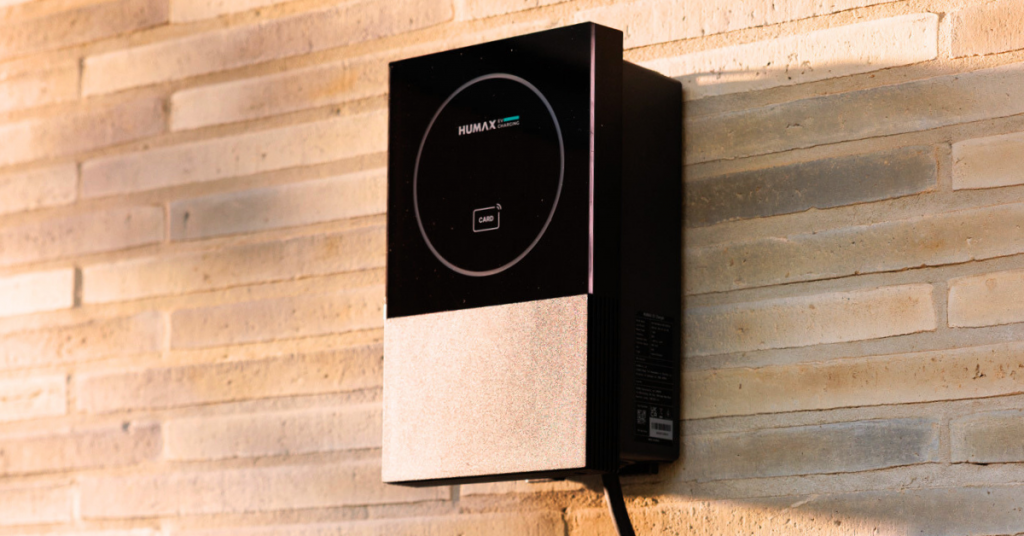
The ideal solution for most EV drivers is a fast charger that can still be operated on a standard single-phase supply, such as the Humax MX7 Smart EV Charger. These devices are more advanced than using the three-pin-plug cable included with your vehicle, and they will need professional installation by a licensed electrician – but they don’t require a new power supply or the associated costs.
At 7.4 kW, this generation of smart chargers can comfortably deliver a full charge overnight for 50–80 kWh batteries – think Audi Q4 or Tesla Model 3 – without stressing your home electrics. If you’re just topping up for a short trip to the shops or a school run, you can be ready to go in an hour or so. They’re also quieter and run cooler than more powerful chargers, making them better suited to domestic use, especially for smaller homes.
The Smart Features That Matter
Buying an EV is a significant investment, so it makes sense to also invest in a charger that helps you make the most of your vehicle’s capabilities. Look for smart charging features that add flexibility, keep costs under control and ensure security for your vehicle, charger and home.
Scheduling
Smart scheduling features like tariff selection and automated pause/resume mean your charger optimises its charging schedule to take advantage of the cheapest possible energy prices, reducing your monthly bills.
Load Balancing
Dynamic load balancing intelligently manages charging – pausing when another high-demand device like an oven or heat pump is in use to prevent your fuseboard tripping.
Solar Integration
If you have a home solar PV installation, look for a charger that features solar-only mode, or can prioritise using excess solar power during the day over grid electricity.
Usage Tracking
For families with more than one electric vehicle, or regular guests using their EV charger, features like vehicle identification and usage tracking make it easy to manage multiple users.
Futureproofing
If you’re investing in a charger today, you’ll want it to be ready for the technology of tomorrow. Look for chargers that are Vehicle-to-Grid/Vehicle-to-Home enabled so you’re ready when it rolls out more widely.
Ready To Choose Your Charger? Use Our Handy Checklist.
If you’re comparing different charger models and price points, our buyer’s checklist can help ensure you factor in all the elements that matter before making a purchasing decision.
☐ Costs: Remember to factor in installation costs and long-term savings, as well as the purchase price, when comparing costs across options.
☐ Warranty: Look for suppliers who offer extended 3-5 year warranties that include responsive support and periodic maintenance.
☐ Renewables: If you have solar and/or battery storage installed at home, look for a model that integrates with your setup.
☐ Power supply: If you have single-phase power (like most homes), remember that the maximum you can install is a 7.4 kW charger.
☐ Key features: Check for smart features such as intelligent scheduling, vehicle identification, and usage tracking across multiple vehicles.
☐ Roadmap: Look for a reputable supplier with a credible roadmap that covers future innovations, such as V2G/V2H.
Our Recommendation
For a future-ready charger that ticks all the boxes, and comes backed by an established supplier with a long track record in the sector, take a look at the Humax MX7 Smart Charger – with vehicle identification and V2G-readiness as standard, and a 5-year warranty for absolute peace of mind.